
Shirodhara
As part of a series of articles on common misconceptions about Āyurvedic treatments, this article focuses on the famous Shirodhara. Often mistakenly viewed as a simple, relaxing massage when offered outside a medical setting, this practice involves many nuances.
But what exactly is Shirodhara? What is its true role in Āyurvedic medicine?
The word “Shirodhara” originates in Sanskrit: “Shiro” means “head” and “Dhara” represents a “continuous flow.” Thus, Shirodhara refers to a continuous pouring on the head, sometimes translated as “pouring on the forehead.” The term “massage” does not appear in this context. Shirodhara is therefore not a massage in the traditional Āyurvedic approach.
In classical Āyurveda, Shirodhara is part of well-defined medical protocols and never practiced isolated. It constitutes a step in the purification process that accompanies more in-depth therapies.
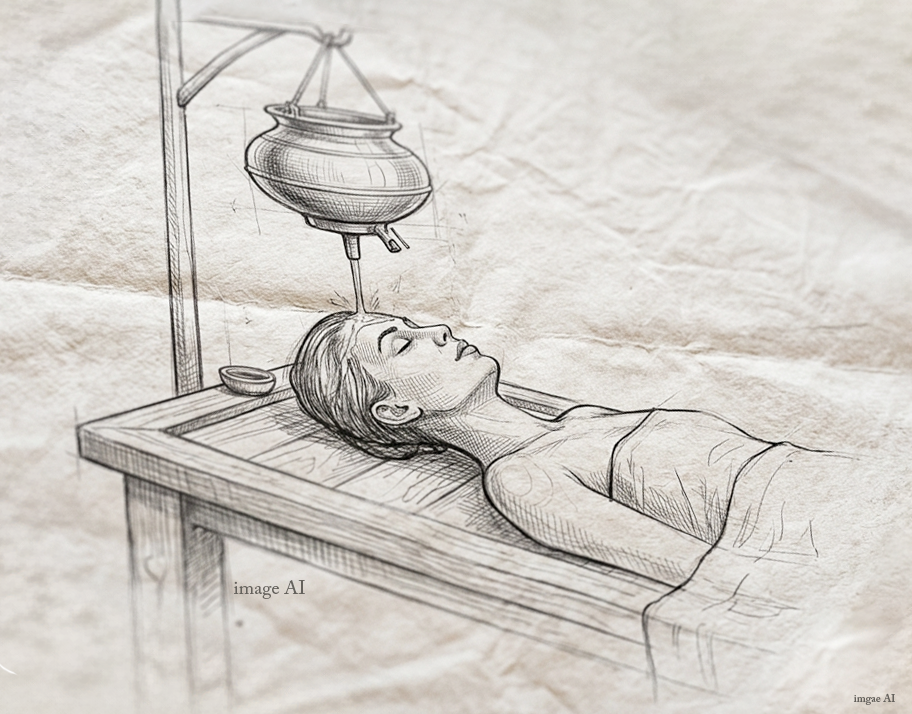
The treatment itself involves pouring a medicinal liquid onto the forehead for a specific duration. The treating physician selects the nature of the liquid based on the individual’s needs. Substances used include medicinal oils, milk enriched with therapeutic ingredients, prepared buttermilk, or herbal decoctions (kashayam). Additionally, the duration of the flow may gradually increase over the course of the sessions.
The total duration of this treatment can be up to 21 days, depending on the body’s response to the therapy. This is an extremely profound method, as the applied substance penetrates through the scalp to the brain and the pituitary gland, where it exerts its effect. Shirodhara acts on the entire nervous system and on the sensory organs, temporarily heightening their sensitivity. It is used to treat various conditions, such paralysis, (including post-stroke) eye or hearing disorders, certain genetic or dermatological diseases, hyperactivity in children, and many other neurological problems. The intense effects of the treatment make the sensory organs particularly sensitive so that they become easily overstimulated.
These effects can be so intense that they sometimes cause sensory overstimulation. Jokingly, one might even say that those undergoing treatment become able to hear the slightest details of their surroundings… to the point of hearing fleas sneeze!
People suffering from sleep disorders or similar issues often fall asleep when the treatment begins—a sign of this method’s remarkable effectiveness. Shirodhara proves particularly effective for hyperactive children (aged around nine to ten). As early as the first or second session, the therapy has a calming effect, and the children are noticeably more balanced.
Proceed with caution: improper use of the treatment can lead to side effects, such as headaches or ear, nose, and throat issues. Sometimes, this can result in complications that manifest long after treatment.For this reason, a qualified professional must perform this treatment in a strictly controlled setting.
Applying the treatment casually then going out into the open air goes against the core principles of this valuable method. One could draw an analogy with a surgical procedure: no one would think of calmly resuming their usual activities immediately after any operation.
Although Shirodhara is undoubtedly very relaxing, it is by no means intended as a simple “relaxation treatment” for everyday use.
As an Āyurvedic doctor said, only systematic practice makes Shirodhara effective; otherwise, it is not Shirodhara.
Classical Āyurvedic texts contain detailed guidelines for the period during and after this treatment. This includes specific instructions regarding cleansing the body (using only warm water) and the head (with medicinally prepared water). Also, doctors advise avoiding exposure to the open air and refraining from intense mental exertion. Even after a short reading, it is ideally recommended to observe a two-hour rest period.
It is therefore always advisable to carefully verify whom you trust, and the potential effects of the treatments and their purpose and original context.